How to Charge a Solar Generator Without Sun (6 Real Methods)
This post contains affiliate links. I earn a small commission if you buy through my links, at no extra cost to you. I only recommend gear I have researched in depth: manufacturer specifications, published teardowns, and aggregated owner reports.
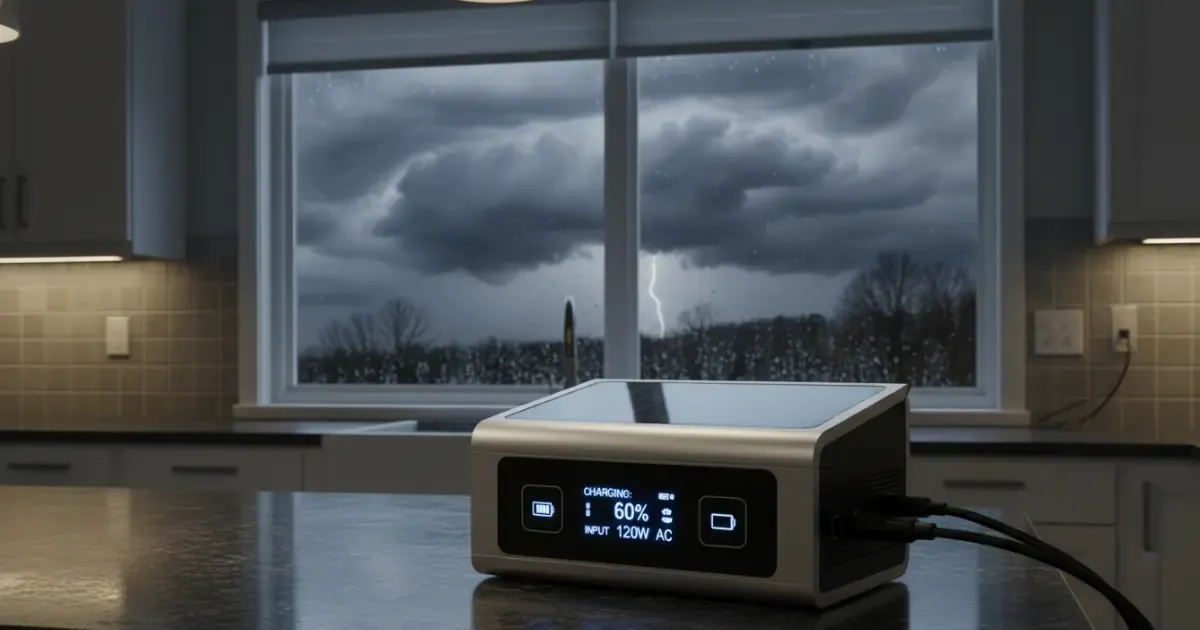
The question comes up after every storm season: what do you do when it is cloudy for three days straight and your solar generator is running low?
Storm seasons often bring overcast skies for days at a time, exactly when you need backup power most. The panels sit there doing very little while the battery drains.
The good news: a solar generator is not just a solar device. It is a battery with multiple charging inputs. Sunlight is just one of them.
Here are 6 methods for charging a solar generator without sun, ranked by speed and practicality. Figures come from manufacturer specifications and simple calculations, not our own tests.
🏠 Homeowners prepping for multi-day overcast outages | 🚐 RV owners boondocking in cloudy weather | 🌀 Storm-zone residents dealing with days of cloud cover | 👪 Parents who cannot afford to run out of power | 🌱 Homesteaders building redundant charging systems | 🔧 DIY builders maximizing charging options
Method 1: Wall Outlet (Fastest — Use This First)
The fastest and most reliable way to charge a solar generator without sun is a standard 120V wall outlet. Every quality solar generator accepts AC wall charging.
Charge times from wall outlet:
- EcoFlow DELTA 3 Plus: about 56 minutes (manufacturer figure)
- Jackery Explorer 1000 V2: about 1.6 hours (manufacturer figure)
- Bluetti Elite 200 V2: check the product page for its wall-charging time; it has the largest battery of the three, so a full charge takes longer
The strategy: Charge your solar generator to 100% from the wall before any storm warning. A fully charged unit is your safety net for the first 24-48 hours regardless of sun conditions.
During rolling outages: Every time grid power returns — even briefly — plug in immediately. Most units support pass-through charging, meaning you can run appliances from the generator while it charges from the wall simultaneously.
Method 2: Car Charging via 12V Outlet
Every solar generator accepts DC input from a car’s 12V cigarette lighter outlet or DC port. This is slower than wall charging but works anywhere you have a vehicle.
Charge rates:
- Standard 12V car outlet: roughly 80-120W of input, which is about 9-13 hours for a full charge on a 1,000Wh unit
- Most efficient for topping up 20-30% while driving
Best use case: Long drives during an extended outage. Plug your generator into the car outlet and drive to check on family or get supplies — you arrive with a significantly fuller battery.
Warning: Do not run your car engine in an enclosed space for charging. Always charge in a well-ventilated area.
Method 3: Gas Generator Input
Connecting a solar generator to a gas generator combines the best of both worlds — you get the clean output and battery storage of the solar unit with the raw power of gasoline.
How it works: Run the gas generator, plug the solar generator into its AC outlet, charge at full wall-charging speed. Once charged, shut off the gas generator. Your solar generator runs the appliances silently and cleanly until it needs another charge.
Why this is smarter than running appliances directly from gas:
- The gas generator runs only while the battery charges, then shuts off
- The power station then runs your appliances silently
- Less running time means less fuel use and less noise exposure
Safety: run a gas generator outdoors, well away from doors, windows and vents, and never in a garage or indoors. Carbon monoxide from gas generators is a leading cause of outage-related deaths.
Gas for charging, battery for running. The generator runs for shorter periods, which cuts fuel use and continuous noise.
→ Solar Generator vs Gas Generator: Full Comparison
Method 4: Cloudy Day Solar (Still Works)
Overcast skies do not eliminate solar charging, they reduce it. These are rough planning ranges and vary with cloud thickness, panel angle and season:
| Sky Condition | Solar Output vs Full Sun |
|---|---|
| Light clouds / haze | 60-80% of rated output |
| Overcast but bright | 25-40% of rated output |
| Heavy cloud cover | 10-20% of rated output |
| Dense storm clouds | 5-10% of rated output |
What this means practically: A 200W panel in heavy overcast generates 20-40W. Over 8 hours of daylight that is 160-320Wh — enough to extend your runtime significantly even if it cannot fully recharge.
Cloudy day solar tips:
- Angle panels directly at the brightest part of the sky, not where the sun would be
- Keep panels clean — dust and debris reduce output more than light cloud cover
- Every watt helps — even 20W input extends your battery life meaningfully
Method 5: Another Battery (Limited)
Some units accept DC input from another battery, but many power stations’ USB-C ports are output-only, so a power bank usually cannot recharge them. Check your model’s list of charging inputs before counting on this.
Best use case: a second battery with a compatible DC output when you have no other source. Treat it as a last resort. The amount you recover is limited by the second battery’s capacity, and it is not a substitute for wall, car or solar charging.
Method 6: Wind and Hydro (Advanced)
Some solar generators accept DC input from alternative sources including small wind turbines and micro-hydro generators. This is an advanced setup but worth knowing:
- Small wind turbines are rated at high wind speeds, so real output in a light breeze is a small fraction of the rating
- A micro-hydro setup on a flowing stream can produce steady power regardless of weather, if you have the stream
For homesteaders and off-gridders building permanent systems, adding wind or hydro can reduce reliance on sun, but check that the source’s voltage and current fit your unit’s DC input before buying.
How to Prepare Before the Storm
The most important charging strategy happens before the outage, not during it.
72-hour preparation checklist:
- Charge solar generator to 100% from wall outlet ✓
- Charge all power banks to 100% ✓
- Fill car gas tank (for car charging and gas generator fuel) ✓
- Store extra gas for gas generator in approved containers ✓
- Check panel connections and clean panel surfaces ✓
- Identify your backup charging priority: wall → gas generator → car → cloudy solar ✓
Wall charging speed varies a lot between brands. The EcoFlow DELTA 3 Plus lists about 56 minutes for a recharge, which helps when grid power returns briefly during a rolling outage.
→ Best Solar Generator for Home Backup (2026)
Best Solar Generators for Multi-Input Charging
EcoFlow DELTA 3 Plus — the fastest wall charging of the three (about 56 minutes), with two 500W solar inputs. Best for users who need a quick turnaround.
Jackery Explorer 1000 V2 — accepts wall, solar (up to 400W) and car input. Solid multi-source charging in a lighter, simpler package.
Bluetti Elite 200 V2 — accepts up to 1,000W of solar input, the most of the three, and has the largest battery. The AC200L this guide used to list is discontinued.
→ How Long Does a Solar Generator Last? (Real Answer) → How to Store a Solar Generator in Winter → Solar Generator vs Gas Generator: Which Actually Wins?
🔋 Buying your first unit — or upgrading?
Charging flexibility is exactly the kind of spec people forget to check before buying — then regret. My Buyer’s Toolkit includes the full pre-purchase checklist from spec research and owner reports: input watts, charge times, and the sizing calculator.
Solar Generator Buyer’s Toolkit — $19
Get the Buyer’s Toolkit →🔗 Related Guides
Frequently Asked Questions
Can you charge a solar generator without solar panels? Yes — every solar generator accepts wall outlet charging, car 12V charging, and most accept gas generator input. Solar panels are just one of multiple charging methods.
How long does it take to charge a solar generator from a wall outlet? The EcoFlow DELTA 3 Plus lists about 56 minutes and the Jackery Explorer 1000 V2 about 1.6 hours. The Bluetti Elite 200 V2 has the largest battery, so check its product page for charge time. Wall charging is generally the fastest method.
Can solar panels charge on cloudy days? Yes — cloudy conditions reduce output by 20-90% depending on cloud density, but solar panels still generate power. Heavy overcast produces 10-20% of rated output. Every watt of cloudy-day generation extends your battery life.
Can I charge a solar generator while using it? Yes — most quality solar generators support pass-through charging. You can run appliances from the output while simultaneously charging from the wall, solar, or car input.
What is the fastest way to charge a solar generator during a power outage? If you have a gas generator, connect it to your solar generator’s AC input for wall-speed charging. Otherwise, car charging while driving is the next fastest option. Always pre-charge from the wall before a storm hits.
Specifications are the manufacturers’ published figures and can change. Charge estimates are calculations, not our own measurements.
Last updated: October 2026