How Long Does a Freezer Last Without Power? (Real Numbers)
This post contains affiliate links. I earn a small commission if you buy through my links, at no extra cost to you. I only recommend gear I have personally tested.
The summer I lost $340 worth of meat taught me something no prepper blog ever explained clearly.
It was not the outage that got me. It was the confidence. I assumed “48 hours” meant I had time. I opened the freezer twice to check. The garage hit 91 degrees that afternoon. By hour 30 the smell told me everything I needed to know.
The 48-hour number is real. But it comes with conditions nobody talks about.
This guide gives you the actual numbers for every freezer type, the variables that shrink your window fast, and the free actions that can push even a half-full freezer past 40 hours before you spend a single dollar on backup power.
🏠 Homeowners prepping for power outages | 🚐 RV owners needing off-grid power | 👪 Parents keeping families safe | 🌱 Homesteaders building grid independence | 🌀 Florida residents prepping for hurricane season
How Long Does a Chest Freezer Last Without Power?
A chest freezer is your best ally during a power outage. Cold air is heavier than warm air and sinks to the bottom — when you lift the lid, cold air stays inside instead of spilling out. This physics advantage gives chest freezers a significant edge over every other appliance in your kitchen.
| Chest Freezer Fill Level | Hours Food Stays Safe | Internal Temp at 24h |
|---|---|---|
| 100% full | 48 hours | ~10°F |
| 75% full | 36 hours | ~22°F |
| 50% full | 24 hours | ~32°F |
| 25% full | 12–15 hours | ~40°F |
Assumes ambient temperature 65–75°F and lid kept sealed. Subtract 30% in rooms above 85°F.
How Long Does an Upright Freezer Last Without Power?
An upright freezer loses cold air every time the door opens because cold air spills out from the bottom of the door frame. Even sealed, upright freezer walls are thinner and less insulated than chest freezer walls. Performance is noticeably worse in every scenario.
| Upright Freezer Fill Level | Hours Food Stays Safe |
|---|---|
| 100% full | 24 hours |
| 50% full | 12 hours |
If you have an upright freezer, the frozen water jug strategy below is not optional — it is essential.
How Long Does a Refrigerator Last Without Power?
A refrigerator keeps food safe for 4 hours with the door kept closed. This is the USDA standard. After 4 hours, discard meat, poultry, fish, dairy, eggs, and cooked leftovers regardless of how they look or smell.
Hard cheeses, butter, whole fruits, and vegetables last longer but should still be inspected carefully before eating.
The 5 Variables That Change Your Entire Timeline
1. How Full Is the Freezer?
Fill level is the single biggest factor in how long a freezer lasts without power. Frozen food acts as a thermal battery — the more frozen mass inside, the more heat energy it absorbs before the temperature rises above the danger zone.
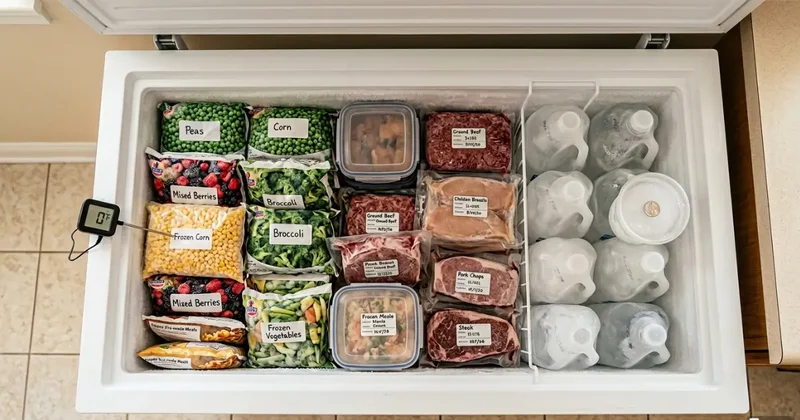
Free fix: Fill every empty space with water-filled gallon jugs and freeze them solid. This costs nothing and adds 10–20 hours to your safety window. Do it before every storm season.
2. How Warm Is the Room?
Heat transfers faster in hot rooms. A chest freezer in a climate-controlled basement at 68°F lasts significantly longer than the same freezer in a garage hitting 95°F on a summer afternoon.
- Room temperature 55–65°F: add 20–30% to the timeline
- Room temperature 85–95°F: subtract 30–40% from the timeline
This is what got me. Garage freezer plus August heat equals a much shorter window than the chart suggests.
3. Is the Lid Actually Staying Closed?
Every time someone opens the freezer to check on food, warm air rushes in and cold air escapes. A single 30-second check costs approximately 2–3 hours of food safety time.
Fix: Tape the lid handle shut the moment power cuts. Make it a non-negotiable household rule. The freezer stays closed until power is restored or you verify temperature with a thermometer.
4. How Old Is the Freezer?
Freezer insulation degrades over time. A freezer more than 15 years old will lose temperature noticeably faster than a modern unit. Foam insulation absorbs moisture over years and becomes less effective.
For freezers older than 15 years, subtract 20–30% from all timeline estimates.
5. What Foods Are Inside?
Dense solid foods — whole cuts of meat, solid vegetable blocks — hold cold far longer than loose items like shrimp bags or ice cream cartons. Pack high-value emergency foods toward the outside walls where heat enters first and less critical items in the center where it stays coldest longest.
Most people buy the wrong size because they only look at running watts. The startup surge is what actually trips the generator. One number changes everything.
→ Surge Watts vs Running Watts: What Every Homeowner Must Know
3 Free Tricks That Add 20+ Hours to Your Window
Do these before you spend anything on backup power. They work, they cost almost nothing, and they take 20 minutes total.
🔧 Frozen water jugs: Fill every empty freezer space with water-filled containers and freeze them solid. Target 90% full at all times during storm season. Cost: $0.
🔧 Moving blankets: Drape heavy moving blankets over the top and sides of the freezer — not over the compressor vents at the back or bottom. The added insulation slows heat transfer significantly. Cost: $15–25.
🔧 The coin-in-cup test: Freeze a cup of water solid. Place a coin flat on the ice surface. Leave it in the freezer permanently. Coin still on top after an outage means the freezer never fully thawed and food is safe. Coin sunk to the bottom means the food thawed and refroze — discard everything without smell-testing it. Cost: $0.
These three actions together can push a well-stocked modern chest freezer past 65 hours of food safety time in moderate conditions.
When Free Tricks Are Not Enough
The blankets-and-frozen-jugs strategy buys significant time. But it has real limits.
A 72-hour outage during a heat wave. Rolling blackouts hitting multiple times per week. A grid failure lasting several days after a major storm. In those scenarios, backup power is the only solution that eliminates the countdown entirely.
The Jackery Explorer 1000 V2 provides 1,070Wh of LiFePO4 power and runs a standard chest freezer for 14+ hours per charge. The EcoFlow DELTA 3 Plus recharges from solar panels in under 2 hours, making it the smarter choice for multi-day outages. Both units run a chest freezer indefinitely when paired with a 200W solar panel.
For a full comparison of which unit fits your specific setup, see the best solar generators for home backup power guide.
Power Outage Food Safety Checklist
Run through this once before storm season. It takes 20 minutes and costs almost nothing.
Before any storm warning:
- Fill all empty freezer space with frozen water jugs ✓
- Store two heavy moving blankets next to the freezer ✓
- Set up the coin-in-cup test and leave it running permanently ✓
- Keep a roll of tape in the drawer next to the freezer ✓
The moment power cuts:
- Drape moving blankets over the freezer immediately ✓
- Tape the lid or door handle shut ✓
- Note the exact time power went out ✓
- Do not open the freezer for any reason ✓
After the outage ends:
- Check the coin-in-cup test before eating anything ✓
- Coin on top: food is safe ✓
- Coin sunk: discard all food, do not smell-test it ✓
- Any food above 40°F for more than 2 hours: discard it ✓
→ How to Prep Your Home for a Power Outage (Complete Guide) → Best Solar Generators for Home Backup Power (2026) → Solar Generator vs Gas Generator: Which One Actually Wins?
Frequently Asked Questions
How long can a freezer go without power before food goes bad? A full chest freezer keeps food safe for 48 hours without power if the lid stays sealed and room temperature stays below 75°F. A half-full chest freezer reaches the unsafe 40°F threshold around 24 hours. An upright freezer lasts 12–24 hours depending on fill level.
How long will a deep freezer last without power? A fully stocked deep chest freezer keeps food safely frozen for up to 48 hours. The dense thermal mass of packed frozen food acts as insulation. Fill empty space with frozen water jugs to maximize this effect and push the window toward 65+ hours.
What temperature does frozen food go bad? Frozen food becomes potentially unsafe when it reaches 40°F (4°C) and stays there for more than 2 hours. Meat, fish, and poultry that reach 40°F should be discarded if held there for more than 2 cumulative hours.
Can I refreeze food after a power outage? Food that still contains ice crystals and has not exceeded 40°F can be safely refrozen, though quality degrades. Food that has reached room temperature or shows no ice crystals should be discarded. When in doubt, throw it out.
How long does a refrigerator last without power? A refrigerator keeps food safe for 4 hours with the door kept closed. After 4 hours, discard meat, poultry, seafood, dairy, eggs, and cooked leftovers. Hard cheeses, butter, and whole fruits and vegetables last longer but should still be inspected carefully.
— Ethan Reynolds is a homeowner and backup power specialist who tests solar generators and emergency power systems for households in regions with unreliable grid power.
Last updated: Apr 23 2026