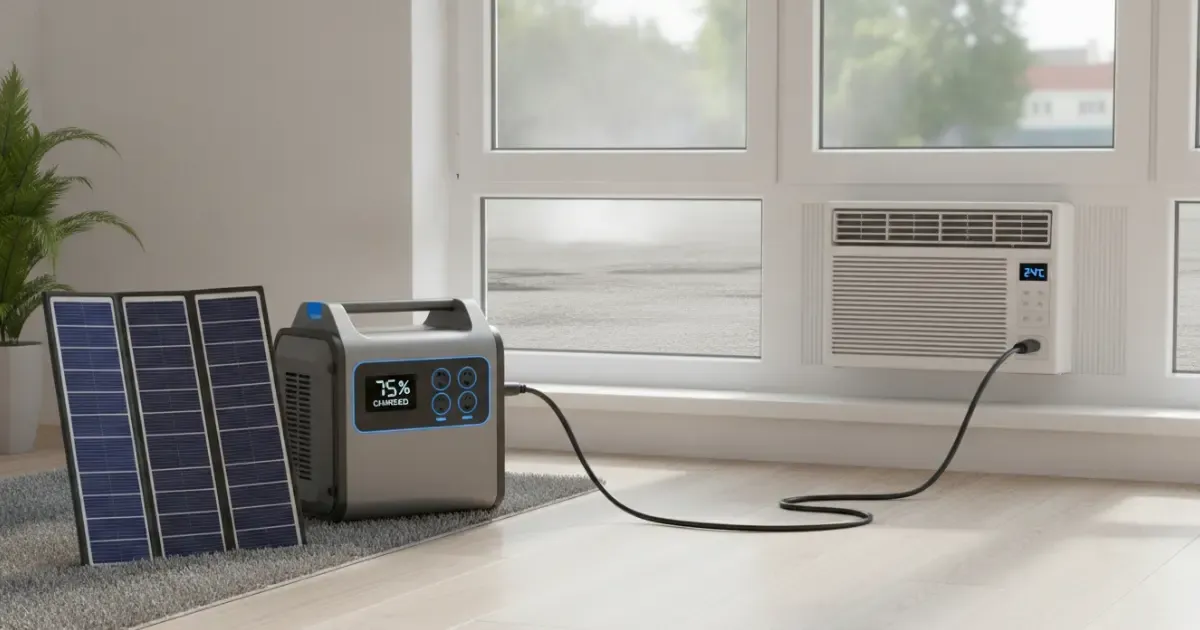
Solar Generator for Air Conditioner: What Actually Works
This post contains affiliate links. I earn a small commission if you buy through my links, at no extra cost to you. I only recommend gear I have researched in depth: manufacturer specifications, published teardowns, and aggregated owner reports.
This post contains affiliate links. We earn a small commission if you buy through our links, at no extra cost to you. Specifications come from manufacturer pages and runtimes are calculations, not our own tests.
Every summer the same question comes up: can I run my AC on a solar generator during a power outage?
The honest answer depends on the type of air conditioner and the size of the power station. This guide works through the math so you can check your own unit.
⚡ The Watt Reality of Air Conditioners
Air conditioners are among the most power-hungry appliances in a home. Before buying anything, check your unit’s nameplate (look for running amps and LRA) or measure it with a plug-in power meter.
Typical figures (they vary a lot by model):
| AC Type | Size | Typical running watts | Typical startup surge | Feasible on a power station? |
|---|---|---|---|---|
| Window AC | 5,000 BTU | 450W | 900W | Yes, for a few hours |
| Window AC | 8,000 BTU | 700W | 1,400W | Marginal; check your LRA |
| Window AC | 10,000 BTU | 900W | 2,000W | Difficult; drains a battery fast |
| Window AC | 12,000 BTU | 1,100W | 2,500W | Not practical |
| Portable AC | 8,000 BTU | 560W | 700W | Yes, for a few hours |
| Portable AC | 10,000 BTU | 700W | 900W | Yes, for a few hours |
| Mini-split | 9,000 BTU | 750W | 1,800W | Marginal |
| Central AC | 2-ton | 2,400W | 5,000W+ | Not feasible |
The startup surge is the critical number. Use the nameplate LRA: LRA × 120 gives startup watts, then add a 20% margin and compare to the unit’s surge rating. Our surge vs running watts guide walks through it.
🏆 Power Stations to Consider
| Model | Capacity | Continuous output | Notes for AC use |
|---|---|---|---|
| Bluetti Elite 200 V2 | 2,073.6Wh | 2,600W | Largest battery here; no motor surge rating published, so confirm your AC’s LRA with Bluetti |
| EcoFlow DELTA 3 Plus | 1,024Wh | 1,800W (3,600W surge) | High surge rating, but only about 2 hours of 5,000 BTU AC |
| Jackery Explorer 1000 V2 | 1,070Wh | 1,500W (3,000W surge) | Fans and small loads; about 2 hours of 5,000 BTU AC |
📏 Calculated Runtimes
Usable energy is 85% of capacity. Runtime is usable energy divided by average watts.
| Load | Elite 200 V2 (~1,760Wh) | DELTA 3 Plus (~870Wh) | Jackery 1000 V2 (~910Wh) |
|---|---|---|---|
| 5,000 BTU window AC, 450W | about 3.9 hours | about 1.9 hours | about 2.0 hours |
| 8,000 BTU portable AC, 560W | about 3.1 hours | about 1.6 hours | about 1.6 hours |
| Box fan, 55W | about 32 hours | about 16 hours | about 16.5 hours |
An AC’s compressor cycles, so real average draw can be lower than running watts, which stretches these numbers. Measure yours to know.
Larger window units
The startup surge of an 8,000 BTU or larger window AC exceeds what many portable stations are rated for. A portable AC usually has a lower startup surge for similar cooling, so consider one if you are buying for outage use.
Central AC: not feasible
A 2-ton central AC draws about 2,400W running and surges to 5,000W or more. That needs a whole-home battery system or a large generator on a transfer switch installed by a licensed electrician.
☀️ Solar Panel Requirements
Running AC drains a battery faster than a small panel can refill it. Using our rule of thumb (panel watts × peak sun hours × 0.75):
- A 200W panel makes about 750Wh on a 5-sun-hour day, which is under 2 hours of a 450W AC.
- A 400W array makes about 1,500Wh on that day, which is roughly 3 hours of a 450W AC.
Clouds and shade cut these numbers a lot, so treat them as best case. Realistically, solar adds a few hours of AC per day on top of the battery, not all-day cooling.
🛠️ Practical Strategies for Outage Cooling
The cooling cycle:
- Pre-cool the room before the outage if you have warning.
- Run the AC from the battery while you need it most, such as bedtime.
- Switch to fans while the battery recharges.
- Run the AC again when the battery is recovered.
Fans first: A box fan on medium (around 55W) moves air and feels cooler. A 1,000Wh-class unit runs a fan for about 16 hours versus about 2 hours for a small AC. In a moderate outage, fans alone may be enough. For more, see what to do during a power outage and emergency power at home.
Thermal mass:
- Close blinds and curtains as soon as the power goes out.
- Pre-cooling the house before an expected outage buys time.
- A well-insulated home warms up more slowly.
The sleeping priority:
Overnight temperature is the usual problem. A 2,000Wh-class unit running a 450W window AC gives about 4 hours of cooling, enough to get to sleep in a small bedroom if you start with a pre-cooled room.
🌡️ Heat Safety
Traverseon lists this 110V portable air conditioner at 4,500 BTU (for about 54–86 sq ft) and 5,200 BTU (about 86–108 sq ft), with a listed power consumption of 350W/450W (the page does not say which figure belongs to which model). It weighs 28.7 lb (4,500 BTU) or 33.1 lb (5,200 BTU), is listed at about 45 dB, and is priced at $699.90 and $789.90. Traverseon states a 30-day return window and does not publish a warranty length, and does not say whether it is compatible with battery power stations.
Calculated runtime at the listed draw (usable = rated Wh × 0.85): at 450W, about 3.9 hours on a Bluetti Elite 200 V2, about 2.0 hours on a Jackery Explorer 1000 V2, and about 1.9 hours on an EcoFlow DELTA 3 Plus. At 350W those become roughly 5.0, 2.6 and 2.5 hours. The compressor’s startup surge is not published, so allow a generous surge margin before pairing it with a smaller station.
Check Traverseon Portable AC PriceAlternatives to Running AC on Solar
Evaporative cooler (swamp cooler): Works in dry climates only. Typically draws far less than an AC. Does not work well in humid places.
Battery-powered personal coolers: Small units cool a limited area and can help for sleeping. Check the wattage and runtime on the product page.
Box fans + ice: A fan blowing across a bowl of ice gives a few degrees of relief in a small space.
Cooling towels + fans: Wet towels with a fan give noticeable relief for almost no power.
🔋 72-Hour Power Outage Survival Kit — $27
Includes appliance watt reference sheet, solar generator sizing calculator, and summer outage cooling guide.
Get the Kit — $27 →Cooling is the hardest load in the house
If an AC clears your surge budget, most other household loads do too. The same math applies to the fridge, the freezer and anything else with a compressor.
Why surge watts decide everything → · Cooling with no power at all → · Full appliance wattage guide →
❓ Frequently Asked Questions
Can a solar generator run an air conditioner?
Yes, for a small window or portable AC and for a limited time. A typical 5,000 BTU window AC draws about 450W running and 900W at startup, so the unit needs a surge rating above your AC’s LRA × 120 plus 20%, and a big enough battery for the hours you want. Central AC is not feasible with a portable power station.
How long will a solar generator run an air conditioner?
With 85% usable capacity, a 2,073.6Wh unit runs a 450W window AC for about 3.9 hours, and a 1,000Wh-class unit for about 2 hours. A 560W portable AC gets about 3.1 hours from the larger unit. Solar panels extend this by a few hours per day in good sun.
What size solar generator do I need for a 5,000 BTU air conditioner?
Look for about 2,000Wh of capacity for roughly 4 hours of cooling, and a surge rating above your AC’s LRA × 120 plus 20%. Typical startup is around 900W, but check your own nameplate. If you choose a Bluetti Elite 200 V2, confirm the startup with Bluetti, since it publishes no motor surge rating.
Is it worth using a solar generator for AC during a power outage?
It depends on your climate and health needs. If cooling is a safety issue for someone in your home, a plan that includes a cooling center or other cool location matters more than any battery. For comfort in a small bedroom, a larger power station can give a few cool hours at night. Fans stretch a battery much further.
Can I run a window AC and refrigerator on the same power station?
Possibly. A 450W AC plus a fridge averaging about 60W is roughly 510W, which a 1,500W+ unit can carry. Start them one at a time so their startup surges do not overlap, and check that the combined surge fits your unit’s rating.
What is the most energy-efficient way to cool a home during a power outage?
Layer it: pre-cool before the outage if you can, close blinds and curtains, use box fans (about 55W), and run an AC only in short bursts, for example at bedtime. A fan uses roughly one eighth of the power of a small AC.
Can solar generators power central air conditioning?
No. A 2-ton central AC draws about 2,400W running with startup surges of 5,000W or more. That needs a whole-home battery system or a large standby generator, both installed by a licensed electrician.
Wattage figures are typical values and manufacturer specifications. Runtimes are calculated, not measured. Last updated October 2026.